



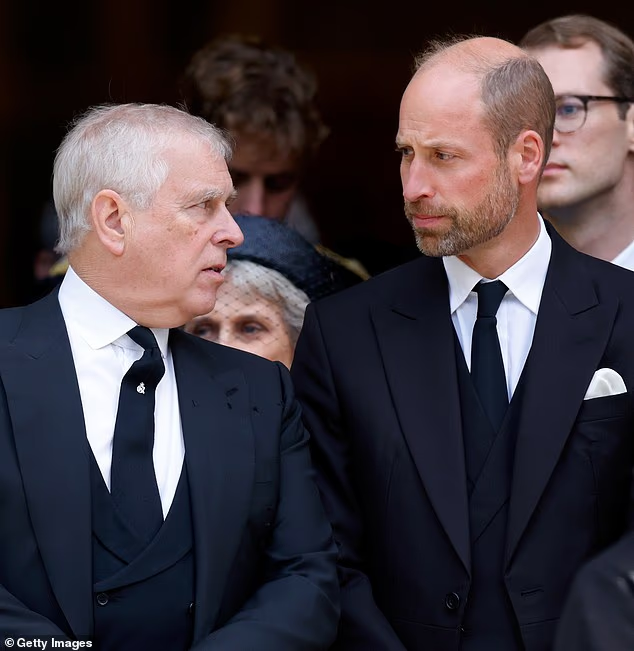
A brief exchange outside the Duchess of Kent’s funeral has taken on new significance one year later — and one royal author believes Andrew’s troubles may still be far from over.
A year after a visibly uncomfortable encounter between Prince William and Andrew Mountbatten-Windsor at the Duchess of Kent’s funeral, the moment is once again attracting attention.
Royal author Andrew Lownie believes the exchange represented a major turning point in Andrew’s dramatic fall from royal life.
The encounter took place outside Westminster Cathedral following the Requiem Mass on September 16.
Andrew appeared alongside his former wife, Sarah Ferguson, while other members of the Royal Family gathered nearby.
But it was his interaction with his nephew, the Prince of Wales, that became one of the most closely watched moments of the day.
An Uncomfortable Exchange With William
According to accounts cited in the report, Andrew attempted to speak privately with William during the gathering.
Footage from the occasion appeared to show William looking uncomfortable during their interaction.
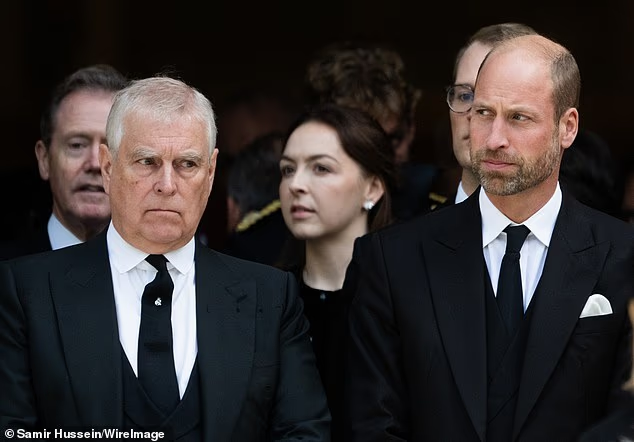
A source previously claimed that William was unhappy with Andrew’s cheerful behavior at such a solemn event and reportedly warned him that laughing in those circumstances was “not a good look.”
Royal author Andrew Lownie later described the encounter as significant because, in his view, it publicly demonstrated just how strained the relationship between William and his uncle had become.
Was Andrew Asking For Forgiveness?
The exchange became even more intriguing after lip reader Nicola Hickling analyzed footage of the encounter.
According to her interpretation, Andrew appeared to use the opportunity to ask William for forgiveness.
Hickling suggested Andrew told his nephew that he had learned from his actions and wanted to know whether William could forgive him.
William, who was accompanied by Catherine, Princess of Wales, reportedly appeared uneasy during the conversation.
The interpretation cannot establish with certainty everything that was said, but it added another layer of attention to an already awkward public encounter.
Lownie Sees The Funeral As A Turning Point
For Lownie, the importance of the encounter goes beyond a few uncomfortable moments captured on camera.
He argues that the funeral represented a pivotal stage in Andrew’s declining position within royal circles.
In the months that followed, Andrew faced further consequences and scrutiny.
The report says his titles were subsequently removed and he was required to leave Royal Lodge.
Lownie believes the images from the funeral helped illustrate publicly just how isolated Andrew had become.
What might once have remained a private family disagreement was suddenly playing out in front of cameras.
The Epstein Controversy Continued To Follow Andrew
Behind the family tensions was the much larger controversy surrounding Andrew’s association with convicted sex offender Jeffrey Epstein.
That relationship has continued to dominate discussion surrounding the former Duke of York and contributed significantly to his withdrawal from public royal life.
According to the report, Andrew was later arrested on suspicion of misconduct in public office over allegations that sensitive information had been passed to Epstein while Andrew served as a UK trade envoy between 2001 and 2011.

Lownie suggested that images of Andrew following questioning helped reinforce the seriousness of his situation in the public eye.
For the royal author, they represented another stage in a downfall that had already accelerated dramatically.
Could Things Become Even More Difficult?
Lownie believes Andrew may still face further challenges.
He pointed to the possibility of additional documentation emerging in the coming months, including material connected to a libel case involving Ghislaine Maxwell as well as further Epstein-related files.
If additional information does become public, Lownie believes it could bring renewed scrutiny to Andrew and his past associations.
For that reason, the anniversary of the Duchess of Kent’s funeral may represent more than simply a reminder of an uncomfortable royal encounter.
It could mark another stage in a much longer story.
William’s Approach To The Monarchy
The report also examines William’s growing influence within the Royal Family.
Lownie has previously suggested that William became frustrated with the way the situation surrounding Andrew was being handled.
King Charles, according to Lownie’s characterization, had been more reluctant to take decisive action against his brother, while William was believed to favor a firmer approach.
As heir to the throne, William cannot publicly dictate every decision made by the monarch, but Lownie believes he has nevertheless exercised considerable influence behind the scenes.
The royal author argues that William is increasingly focused on ensuring the institution he will eventually inherit is prepared for his reign.
Other royal commentators have similarly described the Prince of Wales as capable of taking a tough approach when he believes the monarchy’s reputation is at stake.
One Brief Moment That Came To Mean Much More
At the time, the encounter outside Westminster Cathedral lasted only a short while.
But viewed against everything that followed, Lownie believes it now carries much greater significance.
The images showed Andrew attempting to engage with William while the future king appeared visibly uncomfortable.
In the months that followed, Andrew’s position deteriorated further as controversy and scrutiny continued.
One year later, that brief exchange has become symbolic of something much larger:
the growing distance between Andrew and the future of the monarchy — and a downfall that, according to Lownie, may not yet have reached its final chapter.