



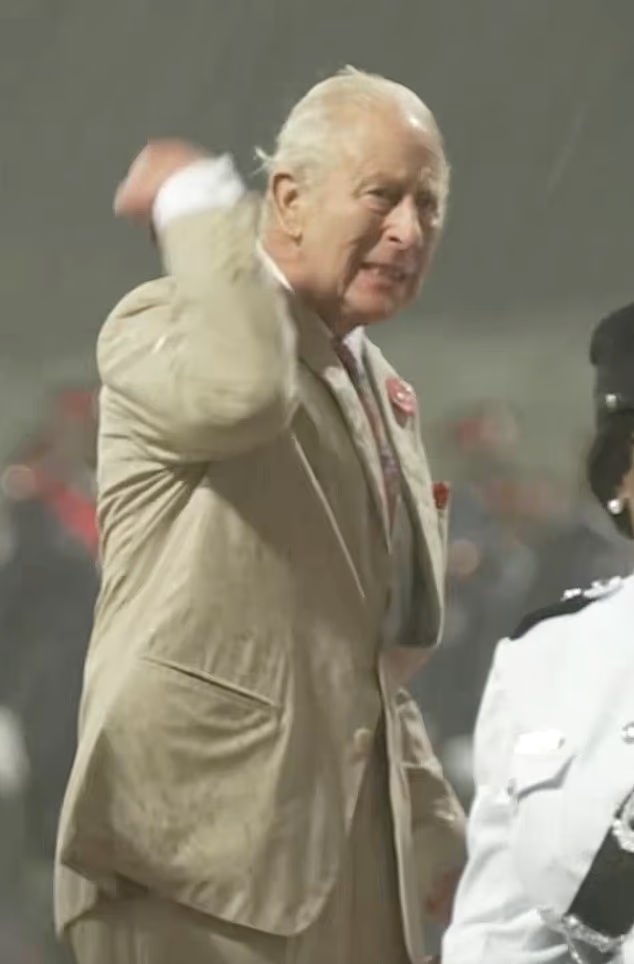
An unexpected tropical downpour left King Charles visibly frustrated during an independence celebration in Antigua, while renewed demands for slavery reparations and calls for the Caribbean nation to become a republic added political tension to the royal visit.
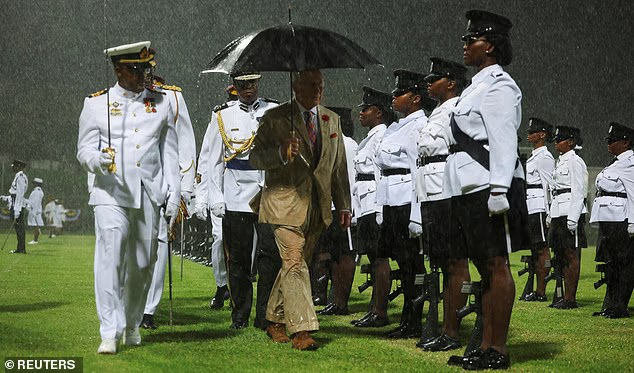
King Charles III found himself at the centre of an awkward royal moment in Antigua when a sudden burst of heavy rain left him standing without an umbrella during an official ceremony.
The incident unfolded at the Sir Vivian Richards Cricket Stadium, where the King and Queen Camilla were attending celebrations marking the 45th anniversary of Antigua and Barbuda’s independence.
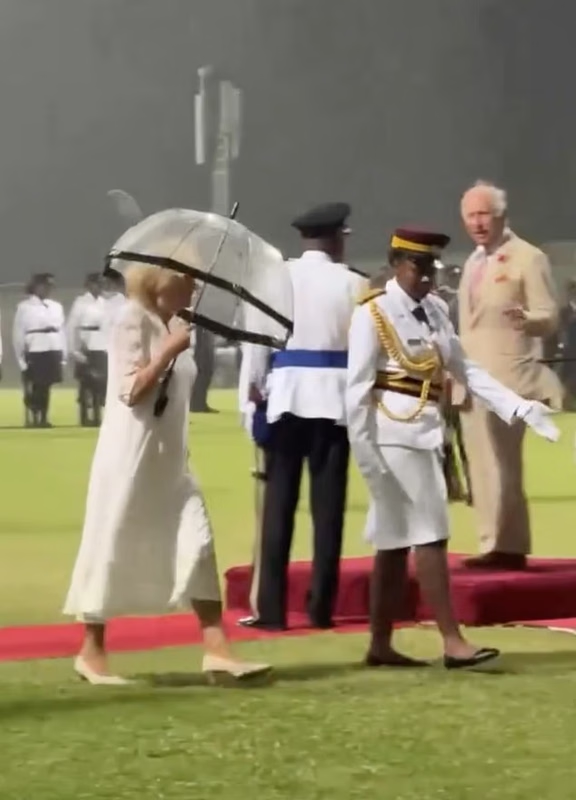
What should have been a carefully coordinated ceremonial appearance briefly descended into confusion as royal staff scrambled to find an umbrella for the monarch.
Charles was seen gesturing towards members of his entourage and apparently asking for protection from the rain as his light-coloured summer suit became increasingly soaked.
The unfortunate timing of the incident attracted particular attention because the visit was already taking place against a politically sensitive backdrop.
Antigua and Barbuda’s Prime Minister, Gaston Browne, had recently renewed his support for replacing the British monarch as the country’s head of state, while also pressing Britain to address its historical involvement in the transatlantic slave trade.
King Charles Appears Frustrated as Royal Staff Scramble for an Umbrella
The unexpected disruption began shortly after Charles arrived at the stadium for the independence celebrations.
As the tropical rain intensified, the King remained exposed on the ceremonial platform while members of his team appeared to struggle to provide him with an umbrella.
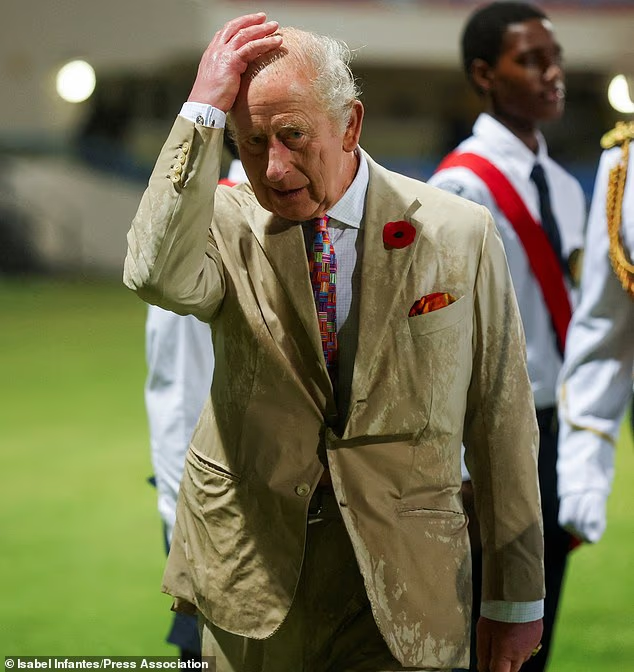
Video footage described in reports showed Charles raising his arms, looking towards his staff and making gestures that suggested he was asking where the umbrella had gone.
At one stage, he reportedly imitated the action of holding an umbrella, apparently trying to communicate what he needed.
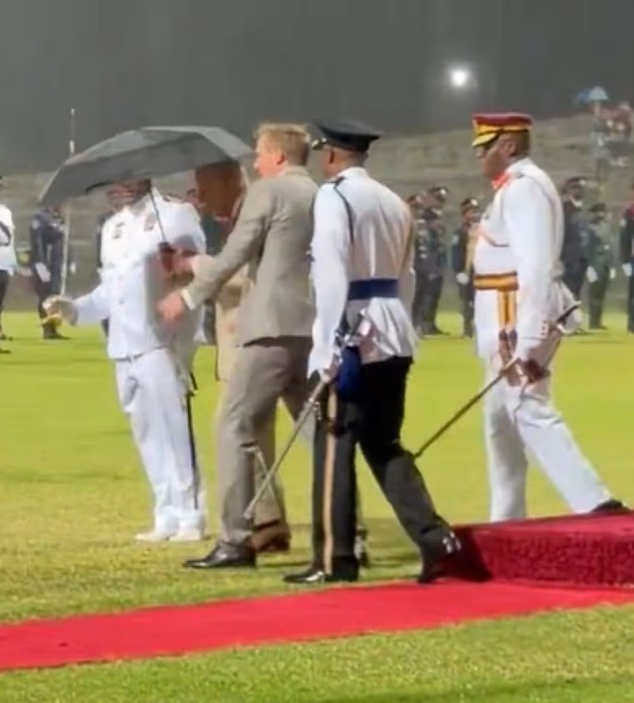
Meanwhile, Queen Camilla was quickly provided with a transparent dome-shaped umbrella and escorted towards the designated royal seating area.
Charles, however, remained in the rain.
The delay appeared to cause some irritation, with the monarch moving around the platform while waiting for assistance.
A member of his security detail was reportedly seen urging staff to act more quickly.
Eventually, Major Ben Rigby, the King’s equerry, retrieved an umbrella from the royal party and brought it to Charles.
By that point, the King’s beige summer suit had absorbed a considerable amount of rain, and water was visibly running down his face.
The incident raised questions about preparations for the outdoor engagement, particularly as royal visits are normally organised with detailed contingency arrangements.
Although the downpour lasted only around five minutes, it created an unusually unscripted moment during an otherwise formal occasion.
The King Finds Humour in an Uncomfortable Situation
Despite his initial frustration, Charles appeared determined not to allow the weather to disrupt the celebrations.
Once the umbrella arrived, he continued with his scheduled responsibilities and inspected military personnel gathered at the stadium.
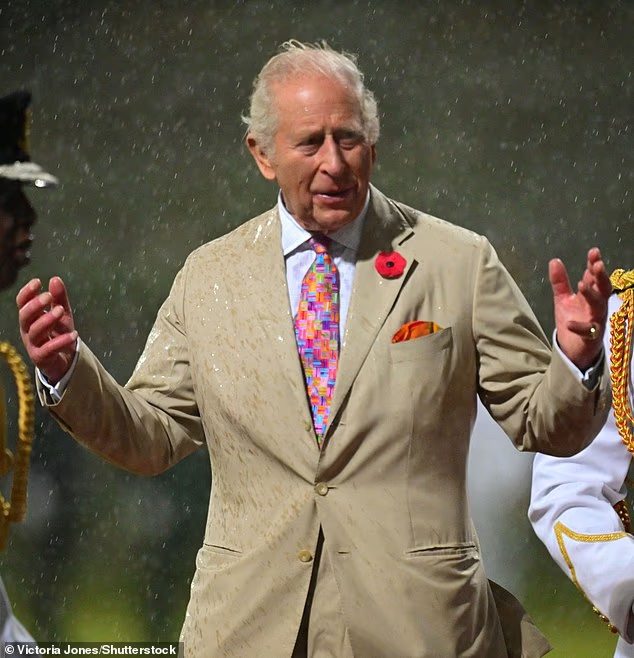
The King was seen occasionally wiping his face with a handkerchief as he carried on with the engagement.
He later reportedly joked that his trousers had become so wet that watercress might begin growing on them.
The lighthearted remark suggested that the monarch was willing to laugh about the incident after the immediate inconvenience had passed.
Camilla also appeared amused by the situation once the confusion had subsided.
As the weather improved, the atmosphere returned to normal, and the royal couple continued meeting participants and guests.
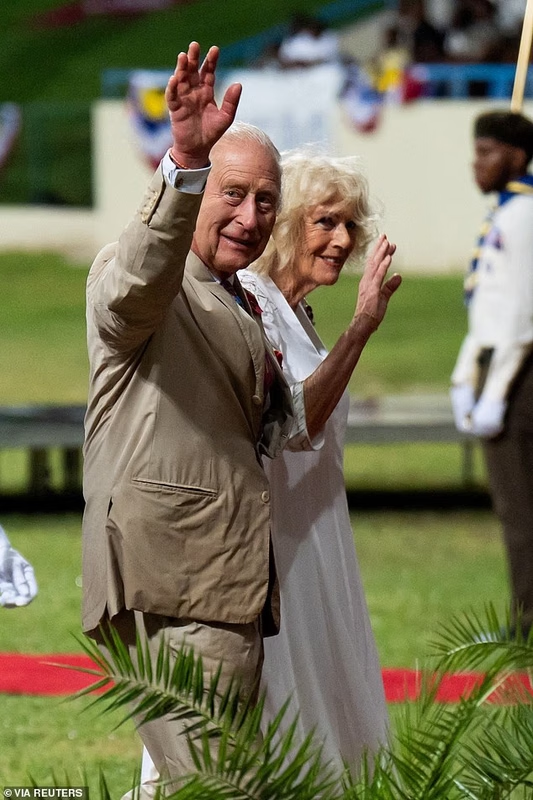
Crowds welcomed Charles with cheers when he returned to the ceremony, and he acknowledged them with a wave.
The brief interruption ultimately became one of the most widely discussed moments of the visit.
However, the political questions surrounding Britain’s relationship with its former Caribbean colonies were considerably more significant than the unexpected rainfall.
Antigua’s Prime Minister Renews Calls for a Republic
The royal visit came at a time when Antigua and Barbuda’s constitutional future was once again attracting attention.
Prime Minister Gaston Browne has repeatedly expressed his personal preference for the country to become a republic rather than retain the British monarch as head of state.
Speaking to ITV News, Browne made clear that he supports a republican system, although he acknowledged that any constitutional change must follow the country’s legal procedures.
He stressed that the ultimate decision belongs to the people of Antigua and Barbuda.
Under the constitutional requirements described in the report, replacing the monarch would require approval from more than two-thirds of voters.
Until such a change takes place, Browne said he would continue to recognise Charles as the country’s King and extend the courtesies associated with that position.
His position reflects a distinction between his personal political beliefs and his responsibilities as prime minister under the existing constitution.
Browne also emphasised that his desire for constitutional change did not mean he lacked respect for Charles personally.
Nevertheless, the debate highlights a broader question facing the monarchy: whether Caribbean nations that gained independence from Britain should continue recognising the British sovereign as their head of state.
Slavery Reparations Become a Major Political Issue
Alongside the republican debate, demands for compensation linked to Britain’s historical role in slavery have become an increasingly prominent issue.
Caribbean leaders have argued that the long-term consequences of the transatlantic slave trade continue to affect their societies and that meaningful action is needed to address those historical injustices.
Browne has maintained that Britain should accept responsibility and consider financial reparations.
He acknowledged that the subject presents political difficulties for British leaders but argued that those challenges do not eliminate the case for compensation.
The Antiguan prime minister also suggested that reparations could be supported through Britain’s existing overseas development resources.
He rejected the suggestion that Caribbean countries were seeking payments beyond Britain’s financial capacity.
For Browne, the issue extends beyond financial compensation.
He has presented reparations as a question of historical accountability and a way of demonstrating that serious abuses can have consequences extending across generations.
In his interview, he warned that a failure to establish meaningful accountability could make it easier for future injustices to occur.
His comments formed part of a wider discussion about historical responsibility, international relations and the legacy of colonialism.
British Political Leaders Divided Over Reparations
The debate has also exposed differences among prominent political figures in Britain.
Andy Burnham reportedly expressed support for a more formal discussion about Britain’s historical involvement in slavery, including the possibility of an official apology.
He called for structured engagement with communities and nations affected by the slave trade.
However, the prospect of direct financial compensation remains controversial.
According to the original report, the British Prime Minister rejected proposals for cash reparations while expressing sorrow and regret over the suffering caused by slavery.
Alternative approaches discussed included debt relief, debt restructuring and support for health and education programmes in Commonwealth countries.
Officials reportedly indicated that any such assistance would need to be financed through existing international aid budgets.
Conservative leader Kemi Badenoch took a different position, arguing against further apologies for historical actions and rejecting demands for financial reparations.
The disagreement illustrates the complexity of the issue within British politics.
Supporters of reparations argue that acknowledging historical wrongs should involve meaningful measures to address their continuing effects.
Opponents question whether present-day taxpayers should be financially responsible for actions committed generations ago.
These competing views are likely to remain central to discussions between Britain and Caribbean nations.
Royal Visit Continues With Independence Celebrations
Despite the weather-related disruption and political tensions, Charles and Camilla continued their programme at the Sir Vivian Richards Cricket Stadium.
The independence parade represented a major part of Antigua and Barbuda’s annual national celebrations.
Military personnel assembled on the stadium grounds as the King carried out ceremonial duties.
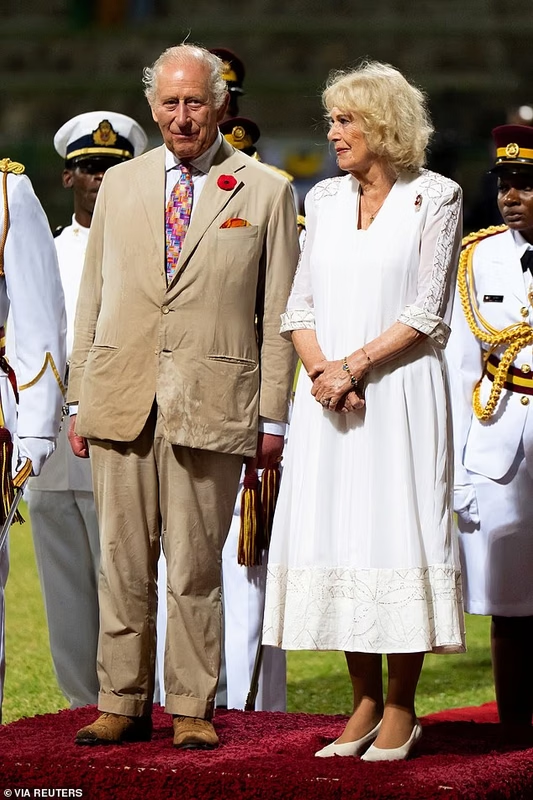
Governor-General Sir Rodney Williams later introduced the royal couple to individuals recognised for distinguished contributions to the country.
The honourees represented a range of fields, including public service, education, culture, sport and community development.
Charles and Camilla also met students and several celebrated figures from West Indies cricket.
Among those present were Sir Vivian Richards, Sir Richie Richardson, Sir Andy Roberts and Sir Curtly Ambrose.
The meeting provided a more relaxed conclusion to a ceremony that had begun with an unexpected challenge.
Cricket Legend Sir Vivian Richards Welcomes the Royal Couple
One of the most significant sporting figures involved in the visit was Sir Vivian Richards, whose name is carried by the stadium hosting the celebrations.
The former West Indies captain is widely regarded as one of cricket’s greatest batsmen.
He played a major role in the team’s World Cup victories in 1975 and 1979 and later captained the West Indies during a highly successful period.
Richards welcomed the opportunity to meet Charles and Camilla on home soil.
Having previously encountered the King at Buckingham Palace, he expressed particular pleasure at receiving the royal couple in Antigua.
He described their presence as a positive occasion for the country and spoke enthusiastically about the significance of the visit.
Richards had also been announced as an ambassador for the Sustainable Markets Initiative, an organisation founded by Charles to encourage more environmentally responsible business practices.
The former cricketer said he considered the role a considerable honour and welcomed the opportunity to contribute to initiatives across Antigua and the wider Commonwealth.
His involvement helped connect the royal visit with the region’s sporting heritage and the King’s environmental interests.
King Charles Takes Part in Commonwealth Cricket Activities
The programme also included a special cricket event involving representatives of Commonwealth governments and Caribbean leaders.
Charles was invited to toss a commemorative coin to determine which team would take the field first.
The symbolic gesture brought a sporting element to the official visit and highlighted cricket’s longstanding importance across many Commonwealth nations.
A separate match featuring emerging players under the age of 23 was also organised to showcase young cricketing talent.
The activities were connected to the Commonwealth Heads of Government Meeting, commonly known as CHOGM.
The gathering brings together leaders from Commonwealth countries to discuss shared priorities and opportunities for cooperation.
The meeting’s stated theme focused on accelerating partnerships and investment to support a more prosperous Commonwealth.
However, discussions about historical injustices, constitutional change and Britain’s relationship with Caribbean nations threatened to become some of the most closely watched subjects surrounding the event.
Could Antigua and Barbuda Eventually Remove King Charles as Head of State?
Browne’s remarks have renewed attention on the constitutional arrangements that continue to connect Antigua and Barbuda with the British monarchy.
Although the country gained independence from Britain, it retained the monarch as its ceremonial head of state.
The prime minister has made clear that he would personally prefer a different arrangement.
Nevertheless, any move towards republican status would require constitutional approval rather than a decision made by the government alone.
Browne acknowledged that Charles would continue to receive the respect and recognition associated with his current position unless voters approved a change.
This creates a situation in which the country’s political leadership can openly support republicanism while continuing to fulfil constitutional obligations to the monarch.
The issue also demonstrates how the monarchy’s future role in the Caribbean is increasingly shaped by domestic political debates rather than decisions taken in London.
Whether Antigua and Barbuda eventually becomes a republic will depend on the choices of its citizens and the outcome of any future constitutional process.
A Royal Engagement Overshadowed by Larger Questions
The sight of King Charles standing in a tropical downpour without an umbrella may have provided an unexpectedly memorable moment, but the incident was only one part of a visit carrying wider political significance.
The discussions surrounding slavery reparations and republicanism reflect longstanding questions about Britain’s historical relationship with the Caribbean.
For some leaders, the priority is securing acknowledgment and compensation for the enduring consequences of slavery.
For others, the focus is on constitutional independence and the symbolic importance of having a locally chosen head of state.
These debates are distinct, although both concern how former British colonies define their relationships with the United Kingdom today.
Charles, meanwhile, continued his ceremonial engagements despite the uncomfortable interruption.
His meetings with national honourees, students and cricketing legends demonstrated the diplomatic and cultural dimensions of the visit.
Yet the wider political atmosphere served as a reminder that the monarchy’s relationship with Commonwealth nations continues to evolve.
The rain in Antigua may have stopped within minutes, but the questions surrounding reparations, historical responsibility and the future of the Crown in the Caribbean are unlikely to disappear as quickly.